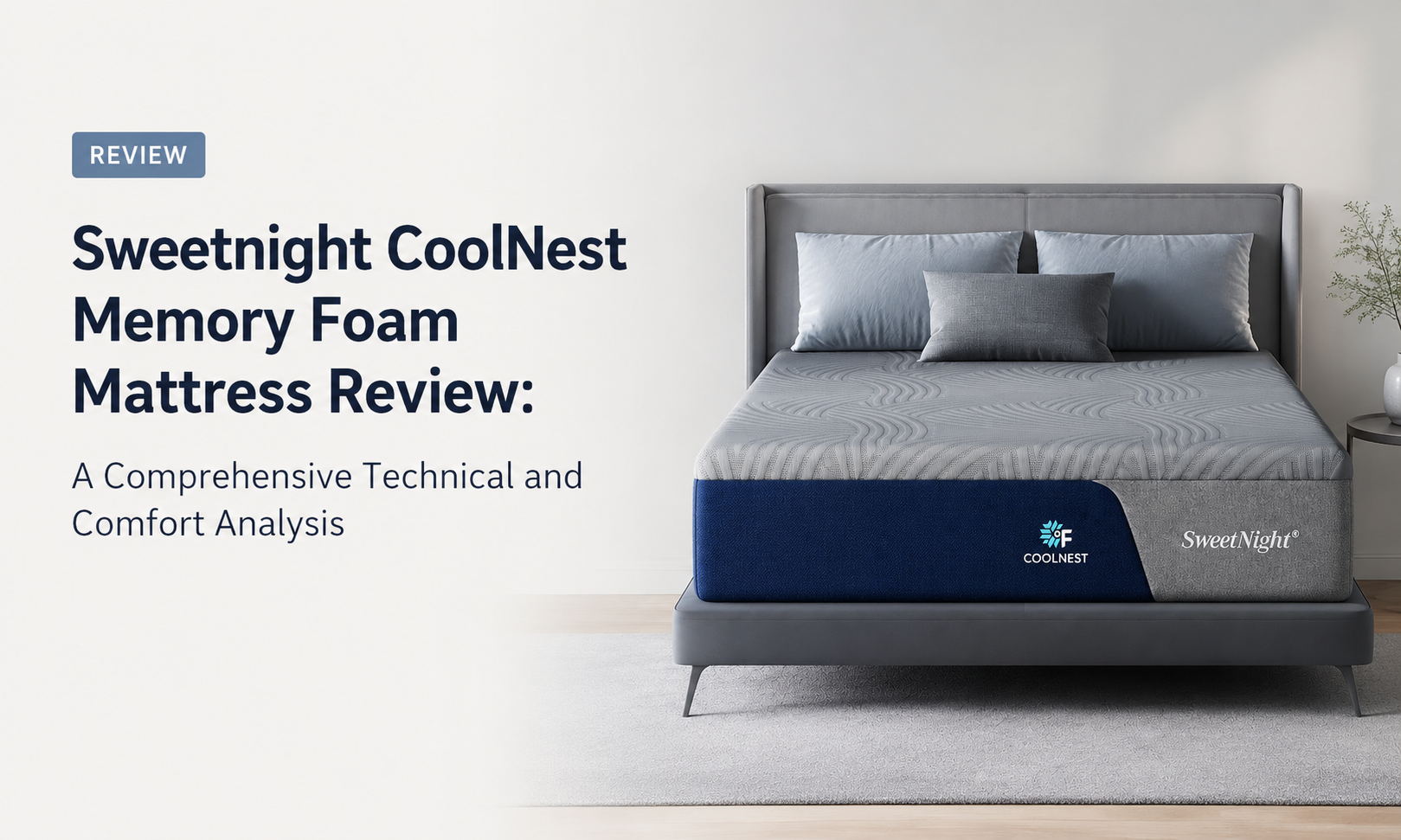
Sweetnight CoolNest Memory Foam Mattress Review: A Comprehensive Technical and Comfort Analysis
The contemporary sleep product landscape has transitioned from traditional retail models to direct-to-consumer, bed-in-a-box solutions. This shift has democratized access to advanced memory foam technologies but saturated the market with aggressive marketing claims. The Sweetnight CoolNest Memory Foam Mattress represents a critical intersection of budget-conscious pricing and advanced materials science.
Engineered specifically to counteract the historic thermal retention issues of standard memory foam, the CoolNest offers complex cooling tech and ergonomic zoning at a fraction of the industry average price. While it delivers exceptional pressure relief and motion isolation, a closer look reveals critical discrepancies between corporate promises and the actual consumer experience, particularly regarding long-term heat retention, edge support, and post-purchase logistics.
How We Reviewed This Product
This review is based on large-scale data analysis using an advanced AI-driven process, including user reviews, expert insights, and product specifications. By synthesizing objective product specifications, quantitative performance evaluations from independent mattress testing laboratories, and a qualitative analysis of verified consumer sentiment, we constructed a multifaceted profile of the product’s true capabilities to separate branding from empirical performance.
Overviews
Sweetnight CoolNest Memory Foam Mattress


Product Description
The CoolNest is engineered to address two primary limitations of traditional viscoelastic foam: insufficient structural resistance and excessive thermal insulation. The mattress utilizes a stratified series of highly specialized, functional layers calibrated to orchestrate a specific biomechanical response.
- The Primary Interface (3D Weaving CoolNest® Cover): Encased in a proprietary 3D-knitted cooling nylon fabric featuring over 10,000 micro-perforations. It delivers an immediate “cool-to-the-touch” sensation, engineered to pull thermal energy away from the skin upon initial contact.
- The Primary Thermal Buffer (PCMflux® High Resilience Foam): The most technologically advanced component. It utilizes a hollow cellular structure infused with microencapsulated phase-change material (PCM) particles. These particles absorb body heat and undergo a latent heat absorption process, maintaining a stable microclimate.
- The Convective Cooling Tier (Gel-Infused Memory Foam): Mechanically perforated with over 700 vertical air channels, this layer expels warm, stagnant air and draws in cooler ambient air when compressed. Saturated with conductive gel particles, it provides a secondary pathway to diffuse localized heat.
- The Biomechanical Transition Layer (Cozy Cushioning Foam): A two-inch responsive support foam that acts as a dampening buffer. It prevents heavier extremities from bottoming out against the dense base foundation, arresting excessive sinkage.
- The Foundation System (5-Zoned Support Foam): A high-density support base featuring nine distinct comfort bars. It yields under protruding shoulders and hips for lateral spinal alignment while remaining highly rigid under the lumbar region to maintain the natural curve of the spine.
Who It Is For
The Sweetnight CoolNest features a standardized firmness profile, generally classified as a “Medium” to “Medium-Firm” (5.0 to 6.5 out of 10). However, its performance varies significantly based on sleeping posture and body mass.
Positional Suitability
- Side Sleepers: Exceptional performance. The upper layers provide the precise viscosity required to let shoulders and hips sink deeply, redistributing weight and keeping the spine in a neutral alignment.
- Back Sleepers: Highly adequate support. The 5-zone ergonomic base provides increased structural rigidity beneath the lumbar region, actively supporting the arch of the lower back.
- Stomach Sleepers: Precarious. Lightweight stomach sleepers may find it adequate, but average and heavyweight stomach sleepers will likely experience severe hyperextension of the lower back, as the plush upper strata lacks necessary pushback for the pelvic region.
Body Weight Considerations
- Lightweight (< 130 lbs): May perceive the mattress as firmer than advertised. Lacking the mass to engage the deeper transition foams, they will experience superficial comfort without a deep contouring hug.
- Average Weight (130 – 230 lbs): The exact engineering demographic. These users will sink through the thermal layers for exceptional contouring while being effectively supported by the transition layers.
- Heavyweight (> 230 lbs): Generally unsupportive. The sheer localized pressure easily overwhelms the plush upper layers, causing the foam to fully compress and lose its pressure-relieving properties, with the exception of dedicated side sleepers who may appreciate the extreme cushioning.
Why It Stands Out
In a saturated market of bed-in-a-box clones, the CoolNest differentiates itself through the aggressive democratization of premium features.
- Disruptive Economic Value: Routine retail pricing sits dramatically lower than the industry average for multi-layer all-foam mattresses. By utilizing a highly streamlined direct-to-consumer logistics model, the manufacturer reallocates capital into material density rather than distribution overhead.
- Complex Thermal Regulation: It brings a three-stage cooling hierarchy (Tactile Dissipation, Latent Heat Buffering, and Convective Airflow Expulsion) to a highly accessible price point. The integration of actual Phase-Change Materials (PCMs) at this budget tier is a massive market anomaly.
- Fiberglass-Free Construction: The mattress entirely avoids the use of woven fiberglass fire barriers, achieving 16 CFR Part 1633 flammability compliance through safe textile engineering. Additionally, all foams are CertiPUR-US® certified, ensuring low VOC emissions and the absence of harmful chemicals.
Pros and Cons
Pros
- Unparalleled Financial Value: Delivers premium phase-change materials and 5-zone support at a severely undercut price point.
- Exceptional Motion Isolation: High-density memory foam absorbs localized kinetic energy, making cross-bed disturbances imperceptible for couples.
- Targeted Pressure Relief: The immediate plush contour and ergonomic base provide exacting cradling for side sleepers, reducing joint ischemia.
- Stringent Safety Compliance: 100% fiberglass-free construction with CertiPUR-US and STANDARD 100 by OEKO-TEX® certifications.
Cons
- Deceptive Trial Logistics: The heavily marketed “100-Night Risk-Free Trial” is frequently obstructed by aggressive corporate negotiation tactics and difficult return processes.
- Severe Perimeter Collapse: Lacks high-density edge rails. Sleeping or sitting near the edge results in structural compression and a “rolling off” sensation.
- Overstated Thermal Claims: Despite advanced technology, the dense foam eventually acts as an insulator, retaining more heat than hybrid or highly ventilated models over a full night.
- Inadequate for Heavy/Prone Users: Lacks the structural pushback to support the pelvic regions of stomach sleepers or users exceeding 230 lbs.
Expert Verdict
Objective testing utilizing pressure mapping grids, thermodynamic sensors, and accelerometers validates several of the manufacturer’s claims while dismantling others. Independent lab tests confirm elite pressure relief, with maximum pressure points registering well below medical pain benchmarks, resulting in a dramatic, body-contouring hug. Motion isolation scores are consistently near-perfect.
However, thermodynamic realities contrast with the “CoolNest” branding. While the phase-change materials successfully delay initial heat buildup, the immense volume of foam acts as an inescapable thermal battery over an eight-hour sleep cycle. Furthermore, edge support is fundamentally compromised, posing a physical hazard for individuals with mobility concerns. Durability projections vary, with material density analysis suggesting a lifespan of 6 to 10 years, noting that thicker profiles with larger volumes of soft comfort foam may degrade faster under cyclical loading.
User Testimonials
Verified consumer feedback reveals a highly polarized, bimodal user base.
- Positive Feedback: Many users praise the immediate comfort and orthopedic relief. One purchaser noted, “The mattress was perfect… the right amount of firmness,” directly validating the efficacy of the zoning system for chronic pain management. Users transitioning from degraded mattresses frequently express high satisfaction with the “luxe” aesthetic and deep contouring.
- Critical Feedback: Negative experiences focus heavily on structural collapse for heavier body types and severe post-purchase logistical failures. One critical review stated, “Worst bed ever. Sinks in so you feel like you are sleeping in a bowl and can’t get out.” Furthermore, numerous complaints highlight corporate friction during the return process, with users reporting frustrating negotiations and unfulfilled refund policies when attempting to utilize the “Risk-Free Trial.”
Specifications
| Mattress Size | Dimensional Footprint (Inches) | Recommended Minimum Room Size | Base Promotional Pricing (12″ Profile) |
|---|---|---|---|
| Twin | 38″ x 75″ | 7′ x 10′ | $329.99 |
| Twin XL | 38″ x 80″ | 7′ x 10′ | N/A (Subject to availability) |
| Full | 53″ x 75″ | 10′ x 12′ | $349.99 |
| Queen | 60″ x 80″ | 10′ x 14′ | $399.99 |
| King | 76″ x 80″ | 12′ x 12′ | $449.99 |
| California King | 72″ x 84″ | 12′ x 12′ | $649.99 |
Note: The mattress is available in 12-inch (Essential Cooling), 14-inch (Advanced Pressure Relief), and 16-inch (Ultimate Cooling & Support) profile thicknesses, fundamentally altering the volumetric ratio of comfort foams to support foams.
Sentiment Summary
- Ergonomic Comfort: Highly bimodal. Overwhelmingly praised by side and average-weight back sleepers for its deep, hugging sensation; aggressively condemned by heavyweights and stomach sleepers for catastrophic sinking.
- Thermal Dynamics: Mixed and contradictory. The initial tactile sensation is noticeably refrigerated, but longitudinal tracking reveals inevitable heat retention as the PCM layers reach saturation.
- Setup & Expansion: Overwhelmingly positive. Minimal toxic off-gassing odors thanks to CertiPUR-US foams, with rapid structural decompression upon unboxing.
- Durability & Sagging: Cautious. Reliance on immensely thick, low-density comfort layers pre-disposes the mattress to macroscopic sagging under heavy cyclical loading.
- Motion Isolation: Unanimously positive. Flawlessly functions as a kinetic shock absorber for co-sleepers.
Conclusion
The Sweetnight CoolNest Memory Foam Mattress is a highly capable, disruptive sleep solution that successfully democratizes premium features. By offering complex ergonomic zoning, phase-change cooling materials, and a safe, fiberglass-free construction at an incredibly accessible price point, it presents an undeniable value proposition for the correct demographic. It is an exemplary, medically sound choice for dedicated side sleepers, average-weight back sleepers, and couples seeking total motion isolation.
However, the mattress is bound by the inherent physics of polyurethane foam. It will sleep warmer than a hybrid model, lacks essential perimeter edge support, and is structurally unsuitable for heavy stomach sleepers. Ultimately, the most profound risk lies in the brand’s antagonistic customer relations regarding the advertised risk-free trial. The CoolNest is highly recommended for value-conscious consumers confident in their preference for the enveloping embrace of classic memory foam, but it should be approached with caution by those relying on a seamless return process.